

 English Malay
  China
China  Türkiye
  France
  Spain
Spain  Vietnamese
  Thailand
  India
India  Русский
  Japan
Japan  Arabic
  Mexico
  Peru
Peru  Argentina
  Korea
Korea  Eng-Canada
  Cambodia
  Philippines
  Bangladesh
  Hong Kong
  Australia
  Singapore
  Colombia
  Iran
Iran In today’s modern financial world, more and more traders are choosing to partner with prop firms to access large amounts of capital without using their own money. However, alongside the potential for attractive profits comes risk that should not be underestimated. This is why the concept of high-risk prop firm trading is being talked about more and more.
So, what exactly is high-risk prop firm trading? How can you seize the opportunity while still keeping your long-term trading journey safe? This article will break it down in a clear, practical, and positive way so you have the information you need before getting started.
What Is High-Risk Prop Firm Trading?

What Is High-Risk Prop Firm Trading?
High-risk prop firm trading refers to traders using capital provided by a proprietary trading firm (prop firm) to execute high-risk trades with the expectation of achieving significant profits in a short period. Even though personal funds are not at stake, traders still face:
- Strict performance requirements
- Tight risk management rules
- The possibility of losing their account if rules are broken
Here, “high-risk” doesn’t mean reckless. It means accepting risk within a controlled framework—where traders must combine skill, psychology, and strategy to overcome challenges.
See now:
- Prop Firm Investment Opportunity – A New Path for Beginners
- Career Development in Prop Firms: Unlimited Opportunities for the Modern Trader
- Prop Firm Support Services: Your Path to Success
Factors That Create High Risk in Prop Firm Trading
High leverage – big profits, big losses: Prop firms often offer leverage from 1:30 to 1:100, allowing traders to control positions much larger than their actual capital. This creates opportunities to multiply profits but can quickly blow the account if risk is poorly managed.
Pressure to hit profit targets within limited time: Most accounts require traders to achieve a set profit target (e.g., 8–10%) within 30 days. This often drives traders into a “win fast” mindset, leading to trades beyond their capability.

Factors That Create High Risk in Prop Firm Trading
Strict drawdown and stop-loss rules: This is a key area where traders often slip up. A sudden price drop or an emotion-driven trade can easily break the allowed loss limit—resulting in immediate account suspension, regardless of whether you were in profit before.
Common Misconceptions in High-Risk Prop Firm Trading
Many people think that since they’re not using their own money, they have nothing to lose. In reality, if you fail:
- You lose the participation or evaluation fee
- You may lose the chance to work long-term with the prop firm
- You lose time and a positive mindset, making it harder to start again
Trading without a plan = account suicide
A common mistake is jumping into the market immediately after receiving the account without a clear strategy. This makes traders vulnerable to emotional decisions and serious errors.
Overtrading correlated pairs – thinking you’re diversifying risk but actually doubling losses
Currency pairs like EUR/USD and GBP/USD often move in the same direction. If you trade both and the market turns against you, you’re not reducing risk—you’re doubling it.
Is High-Risk Prop Firm Trading Worth Trying?

Is High-Risk Prop Firm Trading Worth Trying?
Yes—if you fully understand its nature and have a suitable trading method. Here are some clear benefits of this model:
- Access to large capital without margin deposits
- No loss of personal funds if trades go wrong
- Profit-sharing opportunities as high as 90%
- Evaluation systems that help you develop professional skills
However, you should carefully assess if you’re truly ready—especially in terms of discipline, strategy, and mindset. High-risk prop firm trading is not suitable for those lacking emotional control or those who like to “all-in.”
How to Minimize Risks in High-Risk Prop Firm Trading
High-risk prop firm trading always comes with pressure, but risks can be fully managed if you have the right strategy. Below are practical ways to reduce losses and increase your chances of long-term survival in the market:
Trade with an Asymmetric Risk–Reward Principle
Only enter trades when the potential reward is at least three times the risk (i.e., RRR = 3:1). This helps you protect profits even if your win rate is only average. For example, if you win 4 trades and lose 6, you can still be profitable if you optimize your reward–risk ratio.
Set a Personal Drawdown Limit Lower Than the Prop Firm’s Rule
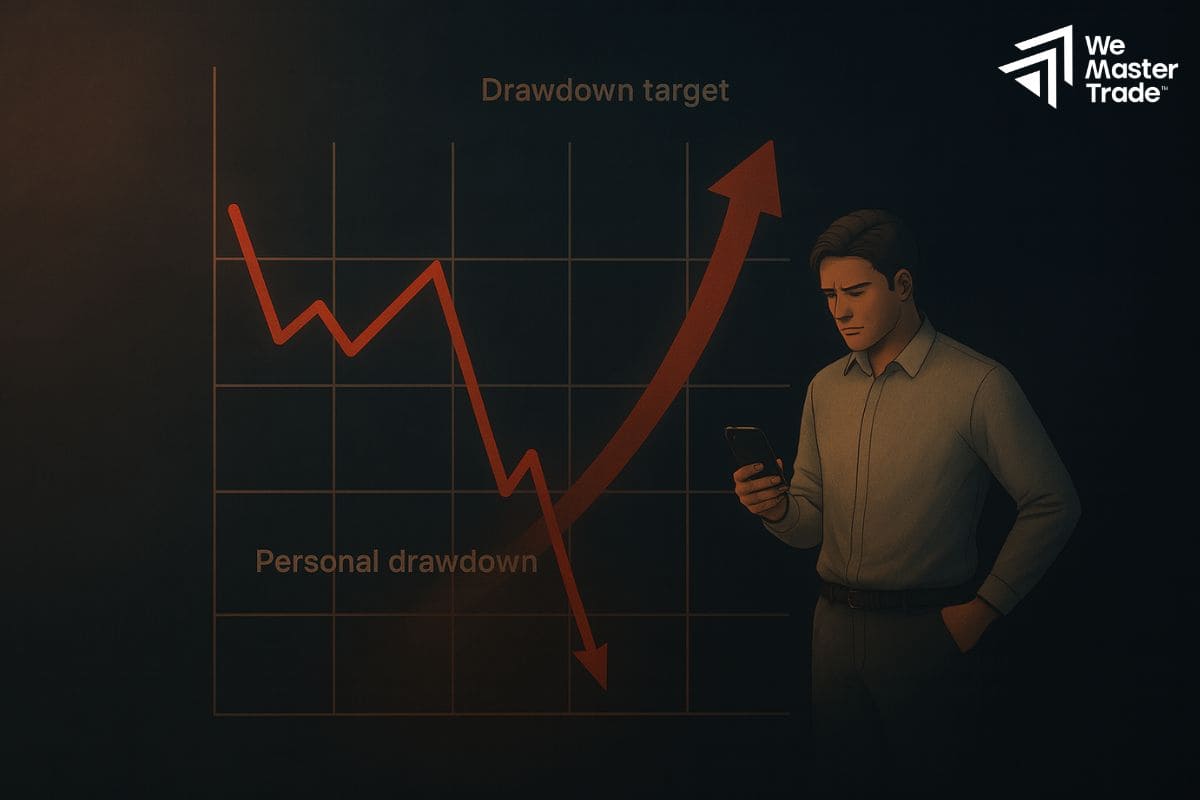
Set a Personal Drawdown Limit Lower Than the Prop Firm’s Rule
If the firm allows a maximum loss of 10%, set your personal limit at 4–5%. Once you reach this threshold, stop trading, review the causes, and adjust your plan—instead of unconsciously trying to “win it back,” which often leads to blowing the account.
Reduce Position Size Before Major News Events
Rather than closing trades completely out of fear, you can reduce your position size to keep some exposure while limiting risk. This is especially useful during high-volatility events such as interest rate decisions, CPI releases, or Nonfarm Payrolls.
Avoid Trading Highly Correlated Pairs
Don’t open multiple positions on pairs that move in the same direction. If EUR/USD and GBP/USD drop simultaneously, trading both can double your losses. High-risk prop firm trading requires you to manage your portfolio’s total exposure carefully.
Control Emotions with a Trading Journal
Record your emotions, trade rationale, and daily results to identify harmful patterns such as revenge trading or FOMO. This is a powerful tool for building discipline—a critical skill when trading with someone else’s capital.
Conclusion
In summary, high-risk prop firm trading isn’t for everyone. But for those who take it seriously and have a clear strategy, it’s a path worth exploring. The key isn’t to avoid risk entirely—but to manage and leverage it effectively. When you understand that each trade is a calculated decision, and you know when to stop or when to push forward, you’ve truly stepped into the professional arena.
See more: