

 English Malay
  China
China  Türkiye
  France
  Spain
Spain  Vietnamese
  Thailand
  India
India  Русский
  Japan
Japan  Arabic
  Mexico
  Peru
Peru  Argentina
  Korea
Korea  Eng-Canada
  Cambodia
  Philippines
  Bangladesh
  Hong Kong
  Australia
  Singapore
  Colombia
  Iran
Iran MetaTrader 4 (MT4) and MetaTrader 5 (MT5) are two of the world’s most popular trading platforms. But which is the best choice for your strategy? This article delves into the core differences: from focusing on Forex (MT4) to multi-asset support (MT5), execution speed, number of indicators, and programming language. Don’t let one platform limit your profits – explore the details before trading!
MT4 vs MT5: An Overview of the Two “Giants”
When entering the world of online trading, every investor will hear of MetaTrader 4 (MT4) and MetaTrader 5 (MT5). Developed by MetaQuotes Software, both are powerful trading platforms, offering professional chart analysis and order execution tools. However, considering MT5 as a perfect upgrade to MT4 is a common mistake.
The truth is, these two platforms were built with different goals in mind. MT4, launched in 2005, focused almost entirely on the Forex and CFD markets. Meanwhile, MT5, launched later, is a multi-asset platform designed to support trading across a wider range of markets, including stocks, futures, and commodities.
So, where do the differences lie, and which is the optimal choice for your trading style? Let’s delve into a detailed comparison.
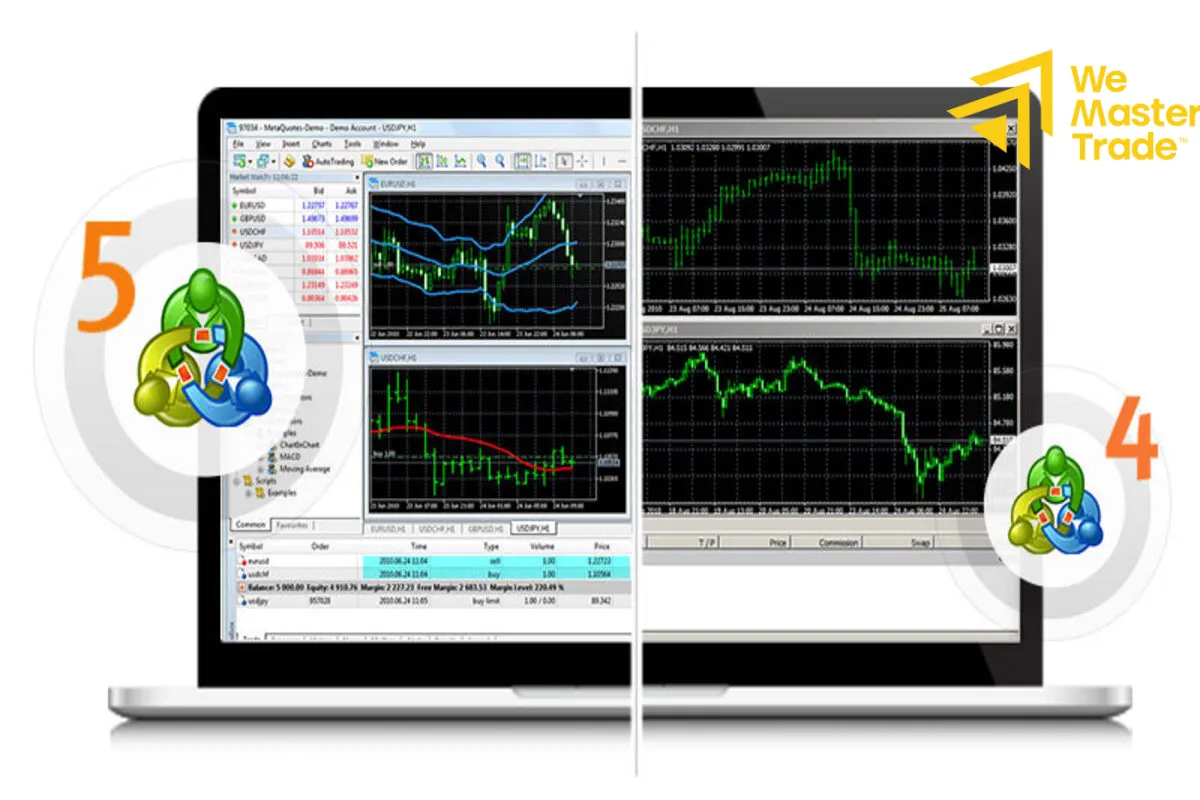
The Core Differences: Tradable Assets & Platform Architecture
The most important difference between MetaTrader 4 and MetaTrader 5 lies in the range of markets they support and their underlying programming architecture.
Tradable Asset Range
| Feature | MT4 (MetaTrader 4) | MT5 (MetaTrader 5) |
| Primary Markets | Forex, CFDs (predominantly | Multi-asset: Forex, CFDs, Stocks, Futures |
| Depth of Market (DOM) | None | Yes (Provides deeper insight into liquidity) |
| Economic Calendar | Not built-in | Built-in (Helps track fundamental analysis) |
If you’re only interested in the Forex market, MT4 might be sufficient. But if your strategy includes trading stocks, futures, or you want to leverage in-depth market information like Depth of Market, MT5 is the obvious choice.
Programming Languages (EAs and Trading Robots)
Both platforms support algorithmic trading through Expert Advisors (EAs), but they use different programming languages:
- MT4 uses MQL4. This language is simpler and easier to learn, and has built a huge library of free or paid EAs and technical indicators.
- MT5 uses MQL5. This is an object-oriented programming language, more powerful and efficient. It allows for faster multi-threaded backtesting, especially useful when testing complex strategies.
Important Note: MQL4 and MQL5 are not compatible with each other. You cannot use an EA written in MQL4 directly on MT5 (or vice versa) without conversion.
See also:
Upgrades to Trading and Analysis Features
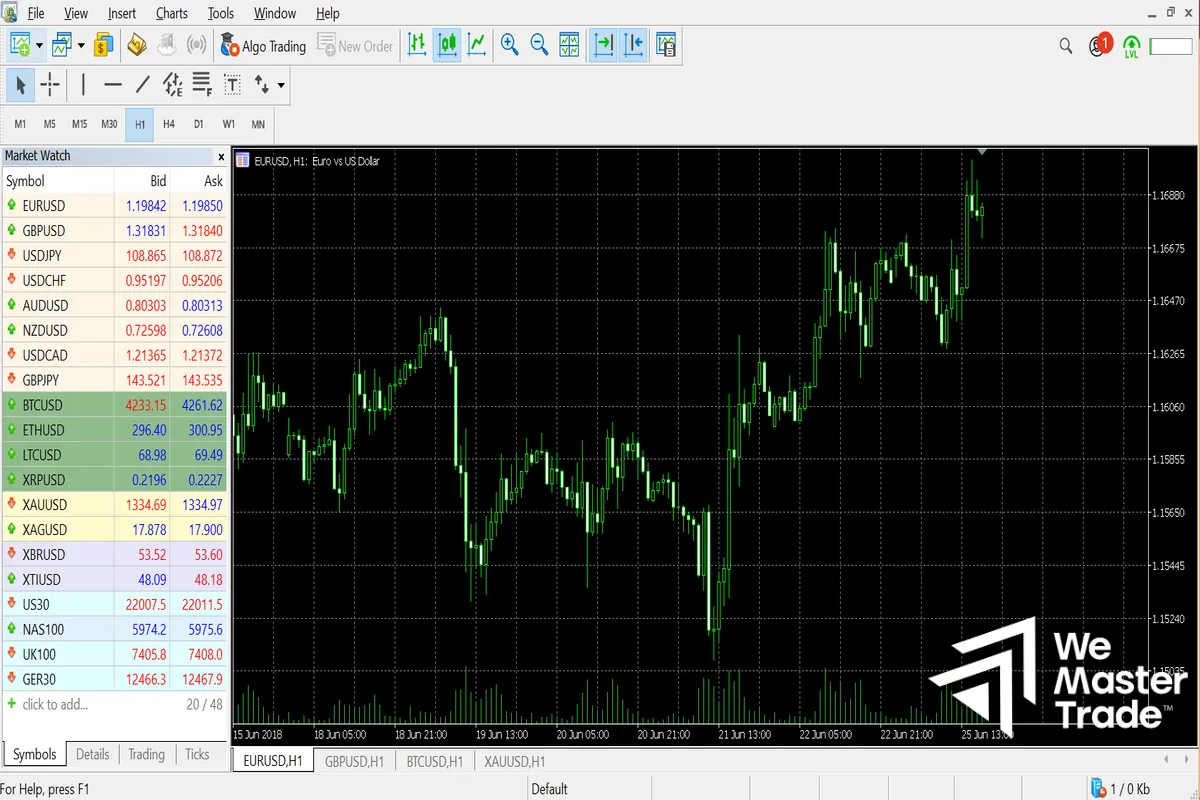
MT5 offers significant improvements that enable traders to perform more in-depth technical analysis, adhering to the E-E-A-T principle of providing high-value tools.
Timeframes and Technical Indicators
One of MT5‘s strengths is the significant increase in analytical tools:
Timeframes:
- MT4: Only 9 standard timeframes.
- MT5: Offers 21 timeframes, including new ones such as M2, M3, M10, H2, H3, H6, H8, and H12. This gives scalpers or day traders a more detailed view.
Technical Indicators and Analysis Objects:
- MT4: 30 built-in indicators.
- MT5: 38 built-in indicators and a large number of chart analysis objects.
Order Modes and Execution
The key difference lies in order processing:
- Hedging Mode: MT4 is designed for hedging by default (allowing you to open both buy and sell orders for the same asset).
- Netting Mode: MT5 supports both hedging and netting modes. In netting mode, if you have a buy order for gold and then open a sell order for gold, the two orders will be combined into a single position. Netting mode is often required for trading concentrated assets (such as stocks) on major exchanges.
- Pending Order Types: MT5 offers two additional advanced pending order types: Buy Stop Limit and Sell Stop Limit, giving traders more flexibility in risk management.
Is MT4 or MT5 Better for Trading GOLD (XAU/USD) and Stocks?
Here are some of the most important related queries investors often ask:
- Gold (XAU/USD) and Forex Trading: Both MT4 and MT5 perform well. However, if you are a scalper and need to leverage live market data, MT5 with its Depth of Market (DOM) feature provides a more detailed view of liquidity, helping you enter trades more accurately.
- Stock and Futures Trading: MT5 is the only option because it is designed to connect directly to centralized exchanges (Exchange-based trading), supporting the mandatory Netting model. Very few brokers can offer real stock trading (non-CFD) on MT4.
Why Is MT4 Still Extremely Popular?
Despite MT5‘s technical improvements and faster order execution speed, MT4 remains the number one platform for Forex trading. The main reasons are:
- Large ecosystem: MT4 has been on the market longer, creating a huge user community.
- Familiarity and ease of use: The MT4 interface is simple and easy to get used to, especially for beginners.
- Abundant EAs: The Expert Advisors library written in MQL4 is unparalleled; many algorithmic traders are reluctant to switch due to the cost and effort of reprogramming.
- Broker support: Almost all brokers support MT4.
Frequently Asked Questions (FAQs) and Recommendations
How are MetaTrader 4 and MetaTrader 5 different?
MT4 is primarily for Forex with Hedging mode and a simple MQL4 language. MT5 is a multi-asset platform (Forex, Stocks, Futures) with Netting mode, more timeframes (21), and a more powerful MQL5 language.
Should I choose MT4 or MT5 if I only trade Forex?
If you’re a beginner and only trade Forex, MT4 is a safe choice due to its popularity and ease of use. However, if you want to take advantage of faster order execution speeds, Depth of Market, and advanced analytical tools, choose MT5.
Will MT4 be discontinued in the future?
Although MetaQuotes is focusing on developing MT5, due to MT4‘s immense popularity in the Forex community, it’s unlikely that MT4 will be completely discontinued in the near future. However, developers encourage switching to MT5 to take advantage of the new technology.
Which platform is more suitable for algorithmic traders (EAs)?
MT5 is technically superior, with extremely fast multi-threaded backtesting capabilities and the modern MQL5 language. However, if you already have a set of EAs running stably on MT4, continuing to use it will be more convenient.
Conclusion and Expert Advice
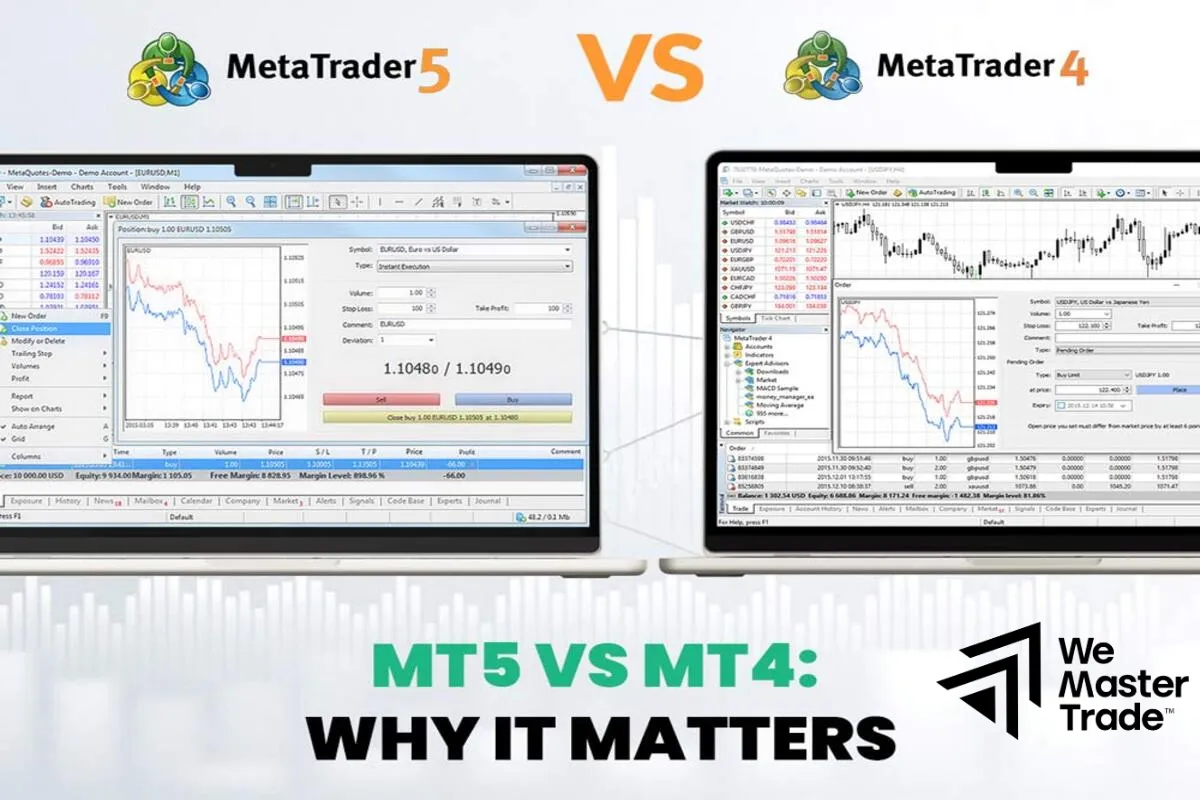
Choosing between MT4 vs MT5 isn’t about choosing the “better platform,” but rather the “platform that better suits” your goals:
- Choose MT4: If you’re a beginner, only trading Forex/CFDs, need a familiar interface, or rely on MQL4‘s built-in EAs.
- Choose MT5: If you trade multiple assets (want to access stocks, futures), need the fastest order execution speed, want to use advanced analytical tools (21 timeframes, DOM), or want to develop complex Expert Advisors using MQL5.
Try a demo account on both platforms to see which one provides the best experience and performance for your personal trading strategy.